

Astronomers measure the distances to relatively nearby stars by watching them appear to shift against more distant stars as Earth changes position in its orbit. NASA calls this stellar parallax: observations made when Earth is on opposite sides of the Sun provide two viewpoints, while the size of Earth’s orbit supplies a known baseline for the geometry. The farther away the target star, the smaller its apparent shift. When that shift is too small to measure reliably, astronomers need another way to estimate distance—one that can be anchored by distances measured closer to home.
What parallax actually measures

Image detailsAI
An illustration of a bright star set against a field of more distant stars.
AI illustration by Cutyssey.
A nearby star does not have to move through space for parallax to occur. The observer moves. NASA’s stellar-parallax explanation describes a star seen at two points in Earth’s orbit, appearing in slightly different positions relative to much farther background stars. Those background stars provide the comparison: the question is not where the target appears on the sky in isolation, but where it appears against a more distant pattern from each viewpoint. A bright star in a field of faint ones makes an intuitive picture, though brightness alone does not establish which stars are nearest.
NASA offers an everyday comparison: hold a thumb at arm’s length and look at it first with one eye, then the other, against a distant background. The thumb seems to jump even though it stays in place. Your eyes occupy different positions, so each gives a different line of sight. In the stellar version, Earth’s changing location supplies the separated viewpoints. This analogy explains the apparent displacement, not the scale of the astronomical measurement: astronomers must measure a tiny angle and know the separation between observing positions to turn the effect into a distance.
Turning a tiny angle into a distance
The geometry is the crucial advantage of parallax. According to the European Space Agency’s explanation of Gaia, the measured displacement—the parallax angle—combined with the known Sun–observer distance lets astronomers determine a star’s distance by trigonometry. A smaller angle corresponds to a greater distance for the same observational baseline. The star’s light need not come with a label saying how luminous it really is; this first step relies on the measured shift and the geometry of the viewing positions. That makes parallax a way to establish distances before using brightness as a more far-reaching tool.
Parallax versus a star’s own motion
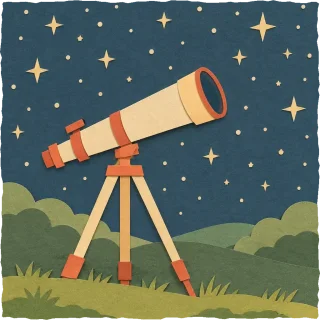
Image detailsAI
An illustration of a telescope pointed toward a star-filled sky.
AI illustration by Cutyssey.
A telescope aimed at a star-filled sky captures only part of that task. One observation cannot reveal which portion of a star’s position is due to Earth’s viewpoint changing. Gaia’s distance-measuring approach, as described by ESA, uses observations at changing viewing positions to measure the displacement. Repeated measurements also help distinguish the viewpoint-dependent pattern from a star’s own motion across the sky. Without that distinction, a change in observed position could be mistaken for a purely geometric shift, or a geometric shift could be lost amid other apparent motion.
Where parallax runs out
Parallax has a built-in limit: as distance increases, the angle shrinks. NASA’s explanation of parallax makes the practical point that the displacement eventually becomes too small for a given measurement to resolve. This is not a particular distance at which geometry stops working. It is a limit set by how small a change an observation can distinguish. Better measurements can reach smaller shifts, but every measurement still has a threshold. The same reasoning explains why moving a thumb farther away makes its apparent jump against the background harder to notice.
Cepheids: stars with a knowable brightness

Image detailsAI
An illustration of a glowing star among faint background stars.
AI illustration by Cutyssey.
A glowing variable star offers a different kind of clue once a direct geometric shift is no longer useful. NASA describes Cepheid variables as stars that brighten and dim periodically; their cycle is related to their intrinsic brightness. Intrinsic brightness means how much light the star actually emits, rather than how bright it looks from Earth. By observing the cycle, astronomers can infer the brightness to use as a benchmark. That does not turn a Cepheid into a ruler with marks along its length. It supplies a known property of the light source that can be compared with what reaches an observer.
NASA’s account of brightness-based distances explains the next step: apparent intensity falls in a predictable way as distance increases. If astronomers know a star’s intrinsic brightness, they can compare that value with its apparent brightness to estimate how far away it is. A Cepheid that looks faint might be intrinsically dim or simply far away; its periodic behavior helps address the first possibility before distance is inferred from the light received. NASA notes that Cepheids can serve as distance indicators over distances of a few tens of millions of light-years, well beyond the nearby-star setting in which its stellar-parallax explanation applies.
How the distance ladder fits together
These methods answer different questions, and their connection matters. Parallax uses a change in viewpoint to establish a geometric distance where the angular shift can be measured. Cepheid-based estimates use an inferred intrinsic brightness and the observed light to work farther out. The distance ladder links the two by grounding brightness-based comparisons in distances established nearer to us; it does not make a distant star’s parallax suddenly large enough to see. The useful takeaway is a sequence, not a single universal technique: measure an apparent positional shift when possible, and use calibrated light from suitable stars when that shift becomes too small.
Sources
Read to the end and earn this story’s drawing
Keep the page open while you read and scroll to the end. The drawing goes to your coloring album.
- Reading time
- Reach the end
You earned this story’s drawing!
Sign in or create an account to keep the drawing in your coloring album.
There are no comments yet. Be the first to join.